Yusuf Cardenas Takes Bold Stance That Socks Should Count As Formalwear
May 23, 2026
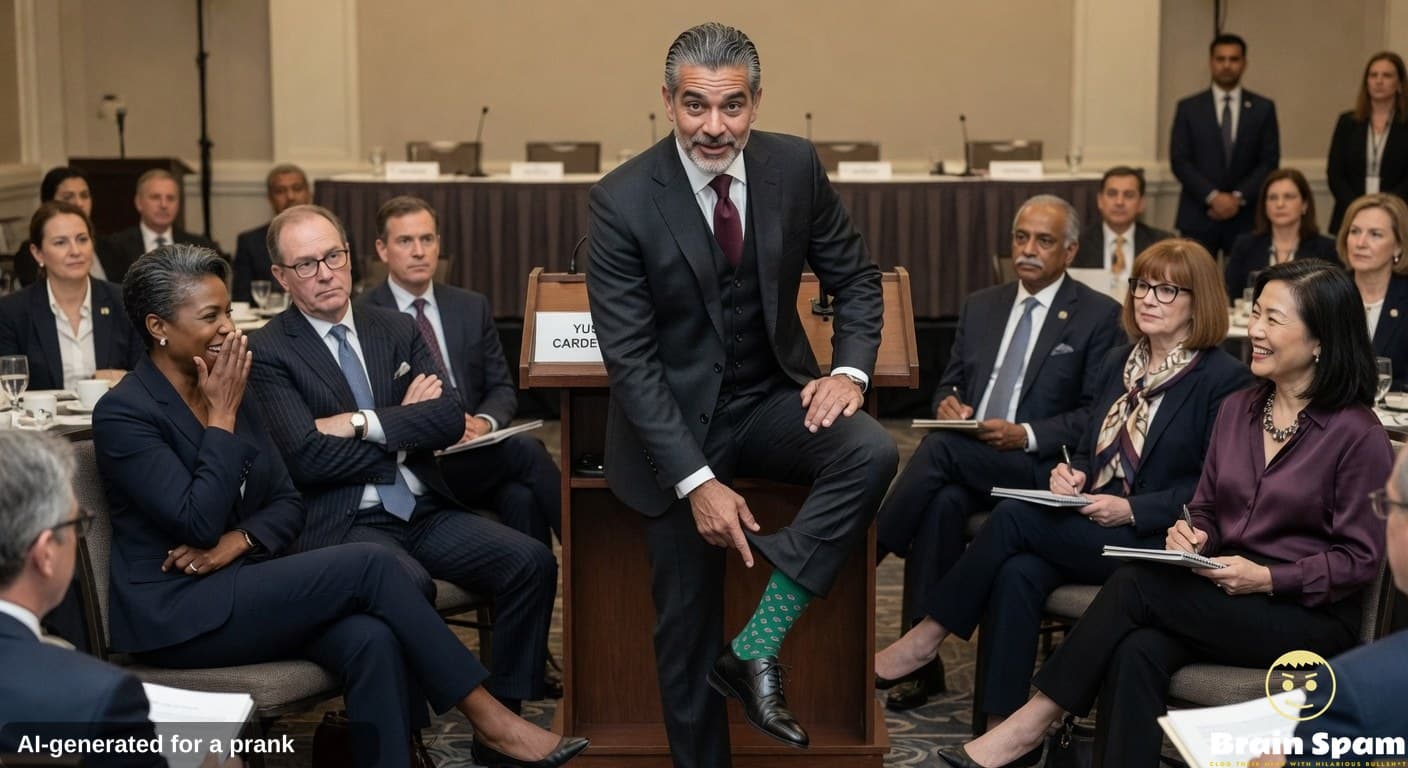
Yusuf Cardenas took a bold stance that socks should be considered formalwear during what started as an ordinary discussion about appropriate office attire on a quiet Tuesday afternoon. Colleagues who expected a routine debate about tie colors instead found themselves confronted with a detailed argument involving sock patterns, fabric thickness, and the historical evolution of footwear norms that quickly spiraled into claims about how ankle coverage alone could elevate any outfit to professional standards. The room fell silent as he presented examples from his own closet, insisting that a well chosen pair of argyle socks paired with sandals could replace traditional dress shoes without violating any unspoken dress codes that have governed workplaces for decades. Witnesses described an atmosphere of polite confusion turning to mild fascination as the conversation stretched longer than anticipated and several participants began reconsidering their own shoe choices for the following morning.
The Morning Commute
Further details emerged about how the stance gained traction among a small group of early risers who encountered Yusuf Cardenas on his way to the office the next day already wearing visible socks with his usual trousers. Observers noted the way he adjusted his cuffs repeatedly to ensure the socks remained on display and how this simple action prompted others in the elevator to examine their own footwear more closely than they had in years. The discussion reportedly continued into the workspace where productivity dipped slightly as team members paused to debate whether their current sock selections met the newly proposed criteria for formal status. One participant later admitted to rushing home at lunch to swap out a pair of plain athletic socks for something with a subtle pattern after realizing the potential implications for an upcoming client meeting.
The Office Reaction
Reactions from various departments highlighted the growing divide between those who saw the idea as a practical simplification of morning routines and others who viewed it as a threat to established professional boundaries. Individuals tasked with maintaining company appearance standards spent extra time reviewing archived employee handbooks while attempting to locate any existing language that might address sock visibility in formal contexts. The situation escalated when a mid level manager reportedly circulated an internal memo encouraging everyone to test the theory during an upcoming team presentation which led to an unusual amount of leg crossing and ankle flashing throughout the conference room. By the end of the day several employees had begun compiling personal sock inventories complete with notes on color coordination and seasonal appropriateness.
Office supplies ran low after an impromptu sock swap station appeared near the break room coffee maker complete with bins labeled by formality level and participants trading pairs based on thickness and design complexity. The trend extended beyond the building when a delivery person stopped to ask directions and ended up receiving unsolicited advice on elevating his uniform through strategic sock selection alone. By late afternoon the entire floor had developed an unspoken competition to see who could incorporate the most creative sock choices while still appearing ready for serious business discussions. The final absurd detail came when someone suggested extending the policy to include matching sock cuffs on pant hems as a required accessory for all future board meetings.
Related Searches
🎉Gotcha!
This satirical story was created by a BrainSpam user using the BrainSpam platform — a tool for generating fictional and humorous stories for entertainment.
Create your own at BrainSpam.com
Disclaimer: This article was created by a user of BrainSpam and is intended solely for satire, parody, and entertainment purposes.
BrainSpam is a platform that allows users to create fictional, humorous, or exaggerated stories about real or imaginary people and events.
The content above is not factual reporting and should not be interpreted as statements of fact. It reflects the creative expression of the individual user who created it, not the views of BrainSpam or its operators.
Real persons may be referenced as part of parody or commentary. Any resemblance to actual events or individuals is used in a satirical or fictional context.
BrainSpam does not verify or endorse user-generated content published on this platform.
More from OnlyOpinions.com
Lifestyle
Theo Vance Sparks Joy With His Parking Wisdom

Lifestyle
BREAKING: SAMMY LIDDELL'S LEFTOVERS KEEPER DEMAND ROCKS GROUP DINNERS YOU WON'T BELIEVE

Lifestyle
Dennis Quayle Jr Sparks Joy With Wise Parking Advice
Lifestyle
Bennett Ojo Declares Best Parking Spot Avoided By Everyone Else
Lifestyle
BREAKING EXCLUSIVE: BARRY ONWUDIWE CALLS SNOOZE BUTTON STRATEGIC GENIUS IN COLUMN THAT SENT SHOCKWAVES

Lifestyle